


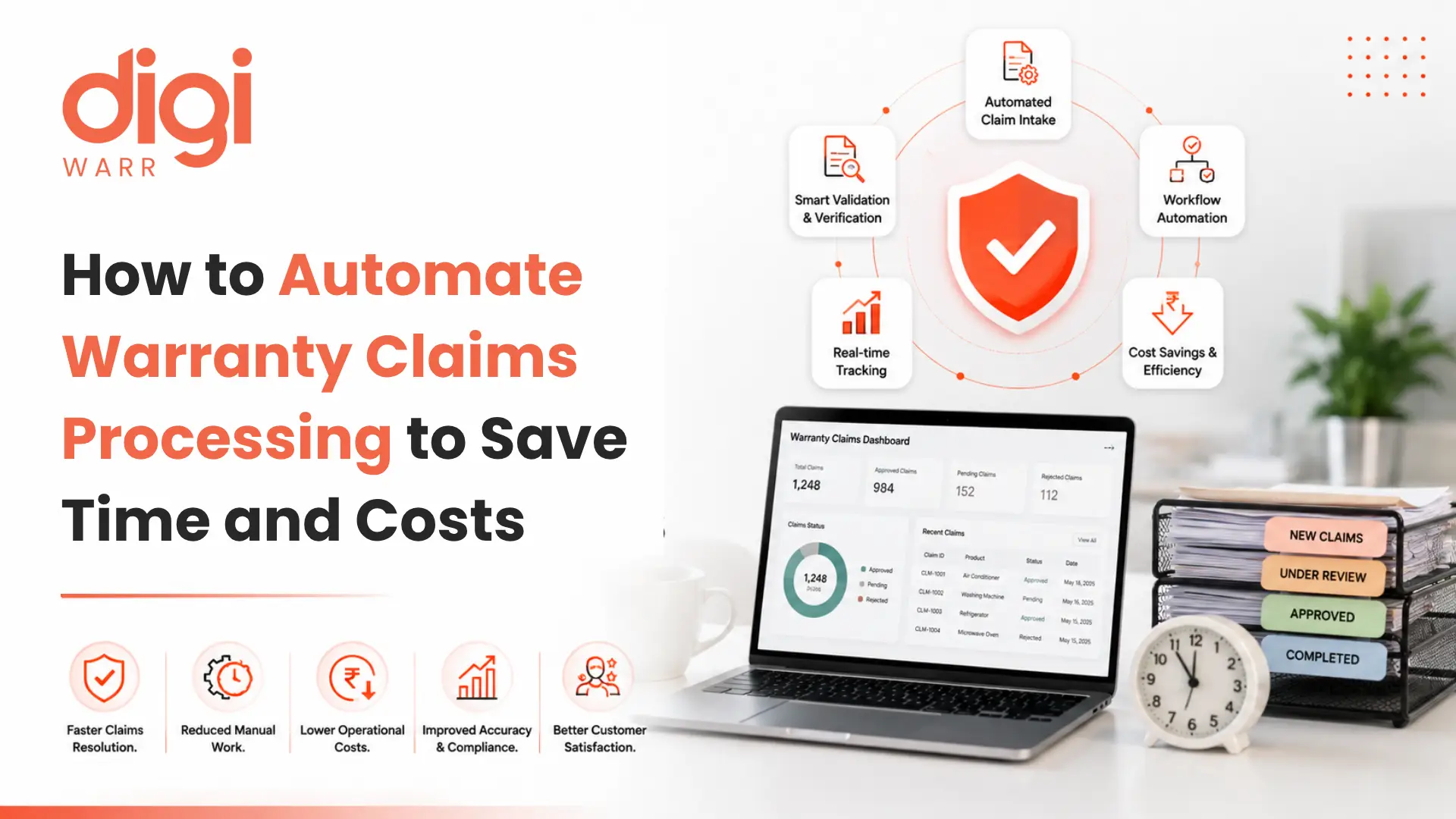
A warranty claim rarely stays in one place for long. It moves from a customer to a dealer, then to a service desk, and from there to someone checking a purchase date and matching a serial number by hand. By the time an answer comes back, days have passed and nobody can say exactly where the delay happened.
This is everyday reality for manufacturers still running warranty operations through spreadsheets, email, and phone calls. Warranty claims processing automation changes that picture, not by removing people from the process, but by removing the manual steps where time and money quietly disappear.
Table of Contents
TogglePicture a distributor sending in a replacement request for a battery that failed within its warranty period. Manually, someone has to pull up the sale record, check the serial number against a register, confirm the purchase date, and pass the claim along for approval.
Automated warranty claims processing works differently. The moment a claim is raised, the system checks the serial number against product records confirms whether the item still falls within its warranty window, and routes the claim to the right person for a decision. A warranty management system built for this already has the information connected, from the day the product entered inventory to the day a customer walked in with a complaint. Judgment calls that matter, like whether to approve a borderline claim, still happen, only faster because the routine checking is already done.
The value looks different depending on where you sit in the business and that is exactly why it matters. A warranty manager sees fewer claims stuck waiting on missing information. A CFO gets a clearer picture of what warranty activity actually costs each month instead of finding out during a quarterly review. An operations manager stops fielding calls about where a claim is stuck because the answer is already visible.
This is not a small concern either. According to McKinsey, warranty costs in advanced manufacturing industries such as automotive, electronics, and appliances can run as high as 5% of product revenue, averaging between 2% and 3%, and most of that comes straight off net margins. For a manufacturer already on thin margins, that is a direct hit to profitability that often stays hidden until someone breaks the numbers down by product or dealer. A manufacturer that once reconciled claims monthly can now see claim status change in real time with warranty management software in place.
Manual processing costs more than most businesses realise, and not only in staff hours. It costs money every time a claim gets approved that should not have been, whether because a serial number was reused, a grace period had already expired, or a dealer submitted a claim for stock that was never officially sold. Much of that cost comes from people chasing information rather than resolving claims, with dealers calling in for status updates because there is no other way to check, and service teams re-entering the same details across different forms. Warranty processing Automation removes this back and forth by giving every stakeholder visibility into claim status without anyone having to ask.
Serial number validation and grace period tracking add another layer of savings by catching claims that should never move forward in the first place, saving you not just money but also the effort of untangling them later, if a dealer sells stock after the permitted grace period without recording the sale properly the system flags the mismatch instead of letting the claim proceed, this is where digital warranty management earns its keep catching the kind of discrepancy a busy service desk might otherwise miss.
Delays rarely come from one big bottleneck they build up from small ones, paperwork that needs tracking down an approval sitting in someone’s inbox a status nobody can confirm without a phone call. Automated workflows remove much of this friction by giving every claim a clear path from the moment it is raised.
Take a claim processed under a block and wait for approval model. The relevant serial key gets restricted the instant the claim comes in, so there is no risk of the same product being processed twice while the manufacturer reviews the case, something a manual setup can easily miss during a busy week. Warranty claims automation does not remove the need for approval decisions, it simply makes sure nothing sits idle while everyone waits for someone to notice it.
Not every part of warranty processing needs the same level of automation, but a few tasks consistently save the most time once handled digitally.
Warranty claim software built around these tasks tends to deliver the fastest, most visible improvement, since they are the steps that consume time without adding much value when done manually.
Accuracy comes down to having the right information available the moment a decision needs to be made. When a product’s full history, its movement through warehouses, its sale record, and its previous claims sit in one connected system, even a straightforward looking claim gets checked properly before approval.
Consider a claim that would likely have been approved manually because the paperwork looked fine at a glance. With automated checks in place, the system compares the dispatch date against the sale record and flags that the grace period had already expired before the claim was raised. That single check can be the difference between a legitimate warranty case and one that quietly pushes up the claim ratio without anyone knowing why. Strong warranty claim management depends on this kind of serial level detail, not just faster approvals.
Automation only delivers on its promise when it covers the full chain, not just the easiest part to digitise.
None of these is technology failures. They happen when automation gets applied in pieces instead of across the full chain, from the vendor all the way to the customer.
Automating warranty claims is not really about replacing the people who currently handle them. It is about clearing away the manual checkpoints where time, accuracy, and money quietly leak out of an otherwise solid process. When serial tracking, grace periods and claim workflows work together instead of living in separate systems, claims move faster, costs become easier to explain and disputes with dealers and customers become far less common.
Want to see how automated warranty claims processing could fit into your current workflow? Connect with Digi Warr to walk through your existing claim process and find out where the gaps actually are.