


A customer walks into a service point with a faulty battery. The team checks everything from the invoice to searching for the serial number, confirms the warranty period, looks for earlier claims and waits for approval before replacement.
For one claim, this may seem manageable. Across hundreds of dealers, distributors, service points, and thousands of batteries, the same process quickly becomes time consuming.
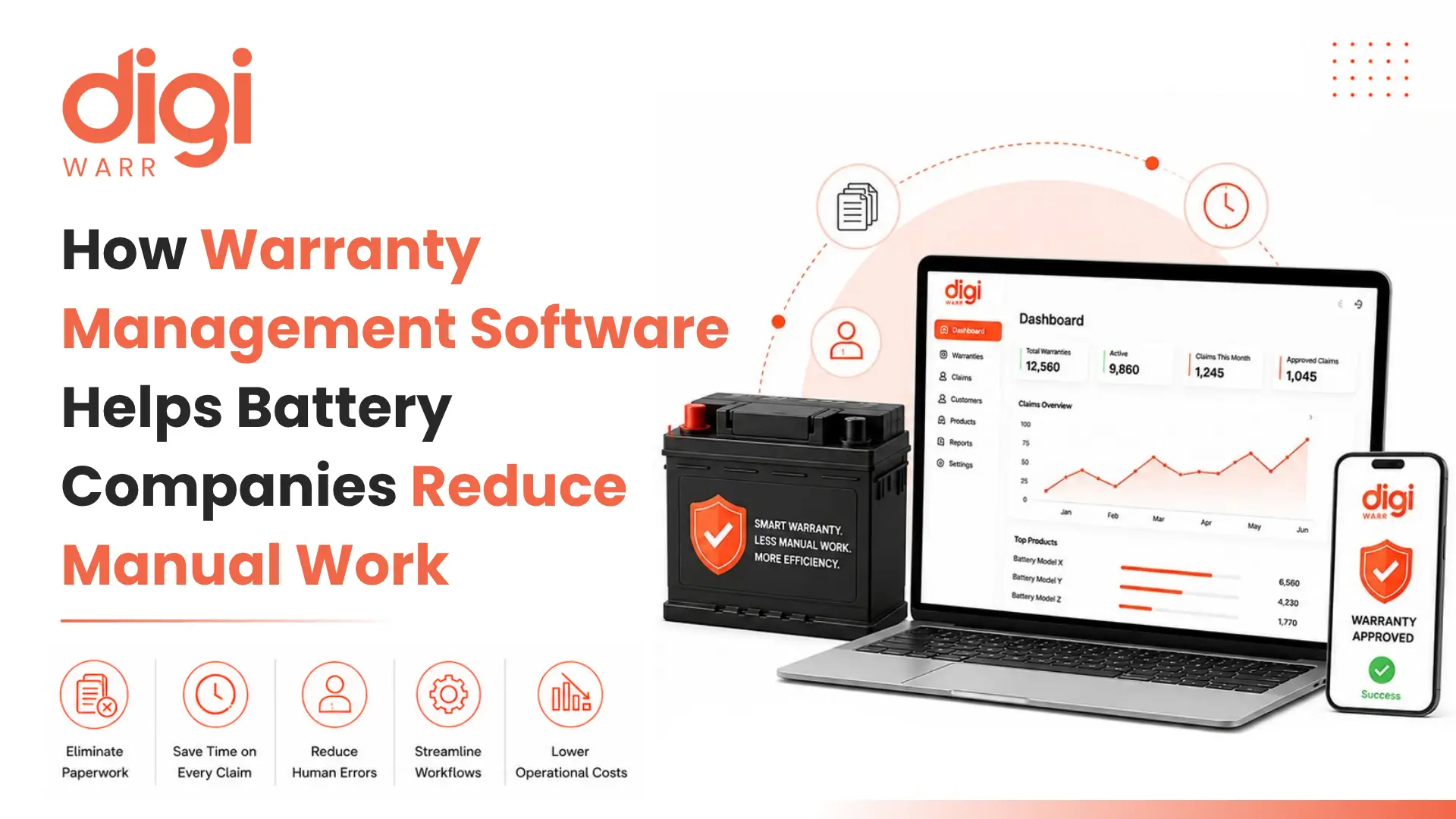
This is where warranty management software for battery companies helps. It brings registration, claim tracking, product history, and approvals into one connected system, reducing repetitive work and giving teams faster access to the information they need.
Table of Contents
ToggleManual warranty management often begins with registers, spreadsheets, warranty cards, invoices, emails, and phone calls. As the business grows, more products, dealers, customers, and claims enter the same process.
Employees may need to check when a battery was sold, whether its warranty is active, which dealer sold it, whether the serial number is valid and whether the same battery has already been claimed.
Battery warranty processes can also involve normal warranty requests, pro rata claims, unsold or transit damaged products, and replacement approvals. Digi Warr’s documented workflow also includes approval based replacement processes and serial key blocking while approval is pending.
Without battery claim tracking software or warranty claim management software, every additional check adds to the employee workload.
The result is simple. Teams spend more time finding information and less time resolving claims.
India’s battery market is growing, which also means more warranty and product data to manage.
According to a December 2025 Ministry of Heavy Industries update based on a NITI Aayog report, India’s annual lithium ion battery demand was projected at around 40 GWh for 2025 and could reach about 210 GWh by 2030.
The Government’s Production Linked Incentive programme for Advanced Chemistry Cell battery storage also aims to create 50 GWh of domestic manufacturing capacity, with an approved outlay of ₹18,100 crore.
As production and sales increase, battery companies may have to handle more warranty registrations, serial numbers, dealer transactions, customer records, replacements, and service requests.
A scalable warranty management system in India allows teams to manage that growth without increasing manual work at the same pace.
The biggest value of digital warranty management software appears in everyday tasks that teams repeat for almost every claim.
Manual warranty registration often requires employees to enter customer and product information into registers or spreadsheets and search for the same information later.
With warranty registration software, the warranty record can stay connected with the serial key, customer details, activation date and warranty period.
When a customer returns months later, the service team can retrieve the record without rebuilding the history from separate documents.
Before accepting a warranty claim, employees may need to answer several questions.
Is the serial number valid? Is the product under warranty? When was it sold? Has it already been replaced?
An automated warranty management system keeps this information connected to the product record.
Instead of calling different departments or checking multiple files, employees can view the relevant details from one place. This makes battery warranty software especially useful for businesses processing a high volume of claims.
Some replacements require approval before action can be taken.
In a manual setup, the service team may receive the battery, contact the company, send information for verification, wait for approval, and then decide whether to replace or return it.
A warranty claim management software keeps these stages visible. Teams can quickly see what is pending, approved, or rejected.
This reduces repeated follow ups and confusion between departments.
A warranty claim becomes easier to evaluate when employees can see the complete product history.
A Battery Lifecycle Management Software can connect purchases, warehouse movement, sales, warranty activity, repairs, replacements, and warranty extensions.
This gives the team a clearer picture of what has happened to a battery throughout its lifecycle.
Reducing manual work also improves the quality of warranty records.
Repeated data entry can lead to typing mistakes, missing information, duplicate entries, or inconsistent claim handling. Digital warranty management software creates a more structured process.
Serial key validation and earlier claim history can also help companies identify suspicious or repeated warranty requests.
One of Digi Warr’s stated goals is to reduce fake claims while making claim resolution, tracking, and battery lifecycle information easier to manage.
The data can also help management study claim trends, replacement patterns, and claim ratios.
This means battery manufacturer software supports both day to day operations and better decision making.
Customers do not see the spreadsheets, calls, approval messages, and internal records behind a warranty claim.
They only see how long it takes to get an answer.
When service teams can quickly check warranty validity, product history, claim status, and approval information, they can respond faster and with greater confidence.
This is an important benefit of after sales service software in India and broader digital warranty solutions in India.
Instead of repeatedly asking the customer to wait while information is verified, employees can explain where the claim stands and what happens next.
Better internal visibility creates a smoother experience for both the employee and the customer.
Not every digital tool reduces manual work.
A useful battery warranty management software in India should support the actual flow of battery warranty operations.
Important capabilities include
The real question is simple.
Does the system reduce the number of manual steps employees perform during a warranty claim?
If yes, automation is creating real operational value.
Digi Warr is built around common battery warranty challenges.
The system supports serial key validation, warranty tracking, claim workflows, grace period management, repair records, warranty extensions, and claim analysis.
Digi Warr also uses the concept of a Product Kundali, which connects important information related to warranty, repairs, and warranty extensions. Its wider aim includes easier claim resolution, timely tracking, visibility into the battery lifecycle, and better understanding of business performance.
For companies looking for warranty management software for battery companies, this means less time spent searching for records and more time spent resolving genuine claims.
Manual warranty processes may work when transaction volumes are small. As more batteries move through manufacturers, distributors, dealers, and customers, those same processes become harder to manage.
A warranty management system in India can reduce repetitive registration, verification, claim tracking, approval, and reporting work while creating a more consistent process.
If your current warranty workflow still depends heavily on paper records, spreadsheets, and repeated follow ups, Digi Warr can help you move toward a simpler and more connected warranty process.
The main benefits include reduced administrative work, faster claim verification, more accurate records, better claim tracking, improved customer responses and clearer warranty analytics.