


Battery businesses handle far more than manufacturing and sales. Every product carries a history that can include dispatch, dealer movement, customer activation, warranty eligibility, claims, repairs, replacements and sometimes warranty extensions.
When this information sits across spreadsheets, paper records, invoices, and separate teams, even a simple warranty request can turn into a long process.
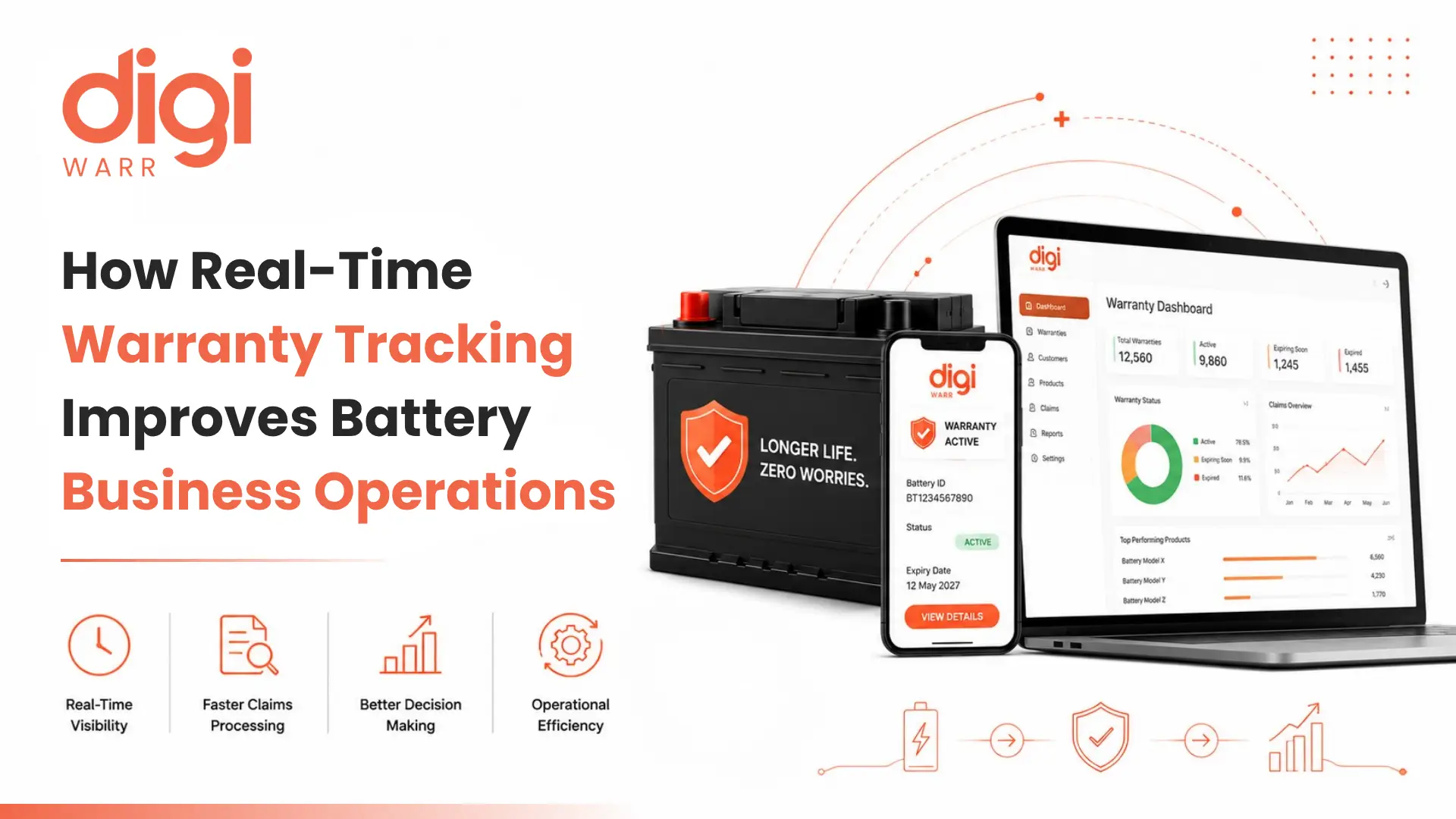
This is where real time warranty tracking Software becomes useful. It helps battery manufacturers see what is happening across the warranty journey as it happens, giving teams better control over claims, product history and after sales operations.
Table of Contents
ToggleImagine a customer arriving at a service point with a battery that needs replacement. The service team now has to confirm when it was sold, whether the warranty is active, who supplied it, whether the serial number is genuine and whether a previous claim already exists.
If those records are scattered, verification takes time.
The problem becomes bigger as product volumes increase. Dealers and distributors hold stock for different periods. Batteries move between warehouses. Claims come from several locations. Some batteries may be repaired, replaced, or granted an extension.
Manual processes make these situations harder to manage.
A battery warranty tracking system brings these records together so teams can see the product journey without searching across multiple files.
For a battery business, the immediate benefit is simple. Less time goes into finding information, and more time goes into resolving the actual customer issue.
India’s battery market is moving quickly at a very fast pace.
According to the Ministry of Heavy Industries, the Production Linked Incentive scheme for Advanced Chemistry Cell battery storage has an outlay of ₹18,100 crore and targets 50 GWh of domestic manufacturing capacity. As of December 31, 2025, 40 GWh had been awarded to four beneficiary firms.
Battery demand is also expected to rise sharply. IBEF reported that India’s lithium ion battery demand could increase from 29 GWh in 2025 to 248 GWh by 2035.
As manufacturing and sales volumes rise, warranty records grow with them.
A business managing a few thousand batteries may be able to work around manual systems. Once product volumes, dealer networks, and claim activity increase, the same process becomes difficult to control.
This is where warranty tracking software India becomes important. It gives businesses a clearer view of products moving through warehouses, dealers, distributors, service teams, and customers.
A digital warranty management system India also helps decision makers understand what is happening without waiting for someone to prepare a report manually.
The biggest difference between manual tracking and real time warranty tracking Software is visibility.
Instead of looking for old invoices or calling different teams, authorised users can check the warranty record directly.
Every battery can be connected with a unique serial number or product identity.
That record can include details such as the source of the battery, dispatch information, customer activation, warranty period, previous claims, and replacement history.
This makes Battery Warranty Management Software useful during everyday warranty verification.
A service employee no longer has to depend only on the document presented by a customer. The system can provide supporting product history.
Teams can quickly check whether the battery is still covered, when its warranty began, whether an extension applies, and whether the same battery has already gone through a claim process.
That saves time for both the employee and the customer.
Teams Work From Consistent Records
A manufacturer, service department, and authorised outlet often need access to the same warranty information.
Automated warranty tracking helps reduce the differences and errors between individual records because updates happen within one connected process.
For management, this means fewer gaps in information and better visibility across locations.
Warranty claims are one of the areas where digital tracking can make an immediate operational difference.
With battery warranty claim management, teams can verify the product before moving ahead with approval, rejection, or replacement.
The claim process can include checking.
Battery businesses may also deal with different types of claims.
First, we will need to understand the different types of claims, for example, a normal warranty request happens when the customer raises a claim during the valid warranty period, then there is a pro rata claim that may apply when a customer approaches the business after the warranty has expired and receives a partial benefit instead of a complete replacement, while unsold claims can occur when a dealer or distributor reports stock damaged before sale. Digi Warr’s documented warranty workflow covers these different situations and helps to maintain all of it without any hassle.
A connected battery warranty tracking system helps the team understand which process applies before taking action.
The result is a cleaner claim workflow with less back and forth between departments.
A warranty claim tells only one part of the product story.
Battery manufacturers also need to know where the battery came from, where it moved, when it reached the customer, what happened during its warranty period, and whether it was repaired or replaced.
This is where battery lifecycle management software adds value.
A complete battery record may include
Digi Warr refers to this product history as Product Kundali, which can include information related to warranty, repairs, and warranty extensions.
For the manufacturer, this type of visibility is useful long after the original sale.
If a battery repeatedly returns for service, the history is available. If a customer raises a second claim, the previous record can be checked. If management wants to study performance across a particular product type, the data already exists.
Every incorrect warranty approval adds unnecessary cost.
The challenge is that invalid claims are not always obvious.
A serial number may already have been used. A battery may have been sold after the dealer’s permitted grace period. A product may no longer qualify for warranty coverage. In some cases, records may not match the original sale.
A warranty management software for battery manufacturers gives teams more information before approving a request.
Serial validation can help confirm that the battery belongs to the manufacturer’s recorded stock. Claim history can show whether the product has already received a replacement. Warranty dates can help teams determine eligibility.
Grace period tracking also matters.
Battery companies may give dealers or distributors a defined period to sell stock. If products remain unsold beyond that period warranty complications can arise later. Digi Warr’s workflow accounts for grace period management as part of warranty control.
This makes real time warranty tracking software useful for prevention, not only record keeping.
Warranty records can tell management much more than how many claims were approved.
With Warranty Analytics Software, businesses can study patterns behind those claims.
For example, management can monitor
This data can point to issues that may otherwise remain hidden.
Suppose one battery model starts receiving more claims than usual across several locations. Management can investigate the product, manufacturing batch, dealer handling or service process before the issue grows.
This is where battery business management software becomes valuable from a decision making point of view.
Warranty data can support product quality reviews, inventory planning, dealer management, service operations and warranty budgeting.
Digi Warr’s stated objective includes helping businesses understand claim ratios, warranty trends, and changes in overall business performance through connected warranty information.
Customers rarely think about the complexity behind a warranty process.
They simply want to know if their battery is covered and what happens next.
That is why faster access to reliable information improves the customer experience directly.
With after sales service software, service teams can check warranty details without repeatedly contacting different departments.
Customers also receive clearer answers.
Instead of hearing that the team is still trying to find a record, they can receive an update based on actual product information.
Digital warranty solutions India can also help manufacturers maintain a more consistent warranty process across multiple dealers and service locations.
For the customer, that means less confusion.
For the manufacturer, it means a more organised after sales operation and fewer unnecessary follow ups.
Not every digital system will suit battery warranty operations equally well.
A useful digital warranty management system in India should support the complete flow of the product and its warranty.
Battery manufacturers should look for capabilities such as
The goal is to avoid creating another isolated system.
Your warranty platform should connect information that teams already need during everyday operations.
Digi Warr helps battery businesses bring different parts of warranty management into one connected system.
Its workflow supports product tracking from inward movement to warranty claims and replacement activity.
Serial level visibility allows teams to identify individual batteries and review their history.
Warranty claim management helps businesses organise requests, approvals, rejections, and replacements.
Product Kundali provides a clearer view of warranty, repair, and extension history associated with a battery.
Digi Warr also supports expected inward tracking. Businesses can record the serial numbered products expected from a vendor and check whether those products actually arrive. Missing expected stock can then be identified as overdue.
For manufacturers handling growing volumes, battery warranty management software like Digi Warr can reduce manual work while giving teams a clearer view of product movement and warranty activity.
That visibility becomes even more relevant as the Indian battery sector grows. IBEF estimates that the Indian EV battery market could expand from US$2.72 billion in 2025 to US$15.90 billion by 2034, with a reported CAGR of 21.70%.
Growth creates opportunity, but it also creates more products, more customers, more claims, and more warranty data to manage.
Real time warranty tracking helps battery businesses answer important questions faster.
Is this battery still under warranty? Has it already been replaced? Which dealer sold it? How often is this model generating claims? Are warranty costs increasing in a particular region?
When that information is available in one place, everyday decisions become easier.
For battery manufacturers, real time warranty tracking software can support faster claims, clearer product histories, better fraud control, stronger after sales service, and more useful business insights.
As product volumes grow, visibility becomes a practical business requirement.
If you want to bring claims, product history, warranty tracking, and analytics into one connected workflow, explore how Digi Warr can support your warranty operations.