


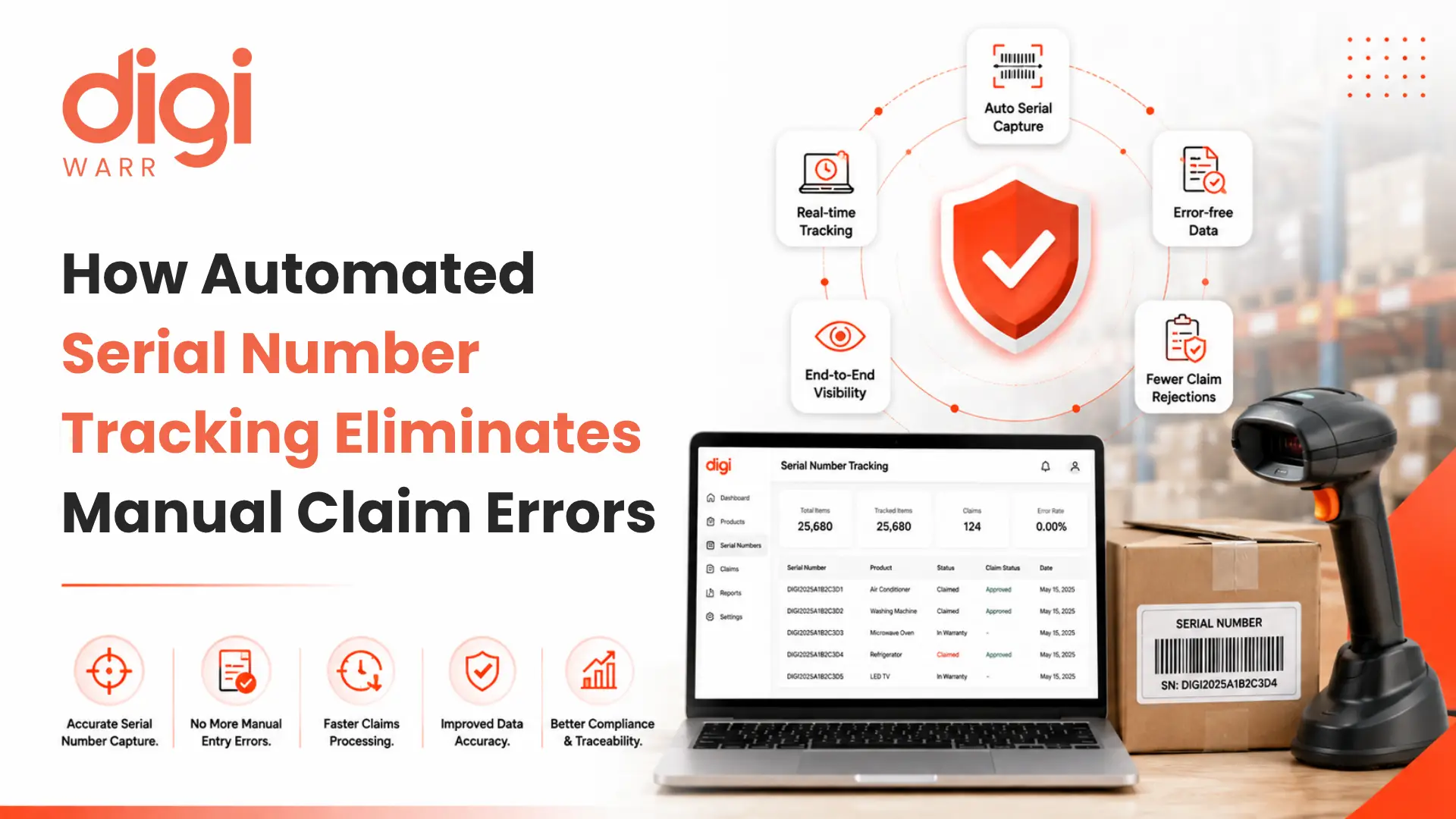
A warranty manager approves a replacement, only to discover weeks later that the same battery serial number was already replaced two months earlier under a different dealer. Nobody lied on purpose. The information simply lived in three different places: a delivery register, a dealer’s notebook and a service team’s memory. Most claim errors that manufacturers deal with every week are not really claim errors at all. They are tracking gaps that surface at the worst possible moment, right when a customer is standing at the counter waiting for an answer. Automated serial number tracking exists to close exactly this kind of gap.
Table of Contents
ToggleEvery product a manufacturer sells carries a serial number, and that number should tell the full story of the product, where it came from, who it was sold to, and what happened after the sale. In practice, that story breaks into pieces the moment the product leaves the factory. A warehouse team logs inward stock in one register, a dealer notes sales in another format and a service centre records repairs somewhere else entirely. By the time a customer raises a claim nobody has the complete picture in front of them.
A serial number management system solves this by recording a serial number once and keeping it linked to everything that happens to that product afterwards, from inward stock and dealer sale to customer activation, service visits and warranty claims. This is the real difference between old style tracking and modern serial number tracking software. It is not about typing numbers into a computer instead of a register, it is about keeping that number connected to its full history, from the manufacturer’s warehouse to the customer’s hands.
Think of a serial number as a thread running through the entire product journey. Vendor supply, warehouse inward, dealer sale, customer activation and eventual claim all attach to that same thread. When a distributor raises a claim, the system can immediately show whether that serial number was sold within the permitted grace period, whether it has already been claimed once before and which dealer originally sold it.
Warranty serial number tracking earns its place in daily operations rather than staying a back office record. A claim stops being a form someone fills out and hopes gets approved and becomes a request the system checks against real history in seconds this gives warranty teams a reliable reference point for every decision built directly into warranty claim tracking.
Most manual claim errors are not caused by careless staff. They come from ordinary human limitations. A dealer forgets to note the exact sale date, a service slip gets filled out by hand and someone later misreads a digit or two entries for the same product end up in different formats and nobody notices until a customer disputes a rejected claim. Add multiple dealers, warehouses, and service points into the mix, and small inconsistencies pile up quickly.
Once a business moves to automated claim verification, the system checks a claimed serial number against inward records, sale history and previous claims before the claim file is even opened, saving you a lot of work. If a serial number does not match what was recorded at the point of sale or shows an existing claim already logged against it, the system flags this instantly instead of letting it slip through paperwork.
Picture a dealer submitting a replacement request for a battery the system shows was already replaced four months earlier. On paper, this could easily go unnoticed. With automated checks in place the duplicate gets caught before any cost is approved.
The value of moving away from manual tracking shows up across the business, not just in the warranty department,
This is why Digital Warranty Tracking matters beyond convenience. It changes warranty data from something reviewed only after a problem occurs into something a business can act on early with warranty management software built around serial level detail giving every department a shared and trustworthy source of truth.
Verification connects directly to how a claim actually moves through approval. In a counter replacement model, the serial number gets checked and cleared almost immediately. In a wait for approval model the manufacturer reviews the claim before replacement happens. In a block and wait for approval model, the serial key gets locked the moment a claim is raised, so the same unit cannot be claimed twice while a decision is pending.
Product serial number tracking makes each of these models work the way they are meant to. Without it, a blocked serial number is just a note someone has to remember to check. With it, the block happens automatically and stays enforced until the manufacturer approves or rejects the request.
Getting started does not require overhauling every process overnight. It usually begins with digitising existing serial records so historical data is not lost, then connecting warehouse inward, dealer sales, and service activity to the same system, so a serial number picks up its full history as it moves through the chain. Setting clear grace period rules for dealers and distributors closes one of the most common sources of disputes early and the final step is choosing a system built around the complete product lifecycle rather than one that only handles claim intake. Automated warranty tracking works best when it captures the full journey, from the moment a product enters inventory to the moment a claim gets resolved.
A few independently reported figures show why this level of control matters at scale, McKinsey has noted that in advanced manufacturing industries such as automotive, electronics and appliances annual warranty costs can run as high as 5% of product revenue and a separate McKinsey analysis found that global automotive warranty costs have nearly doubled since 2012 reaching around 58 billion dollars in 2024, close to 2.2% of industry sales. Academic research citing warranty scholar D.N.P. Murthy places warranty claims and related service costs at 2% to 15% of net sales more broadly. When costs sit in that range even small improvements in claim accuracy translate into real savings.
Manual claim errors rarely come down to careless people doing careless work. They come down to product information that never had one consistent home to live in. Things like one serial number being tracked automatically from inward stock through to the final claim decision mean verification stops being a manual chase and becomes a simple lookup. Businesses catch duplicate claims before they get approved, while dealers get faster answers and management gets a clear view of where warranty costs are actually coming from. This concludes that a system can help not only management but also your dealers, thus giving you a clear picture.
Want to see how automated serial number tracking could fit into your current warranty process? Connect with Digi Warr to discuss your workflow.