


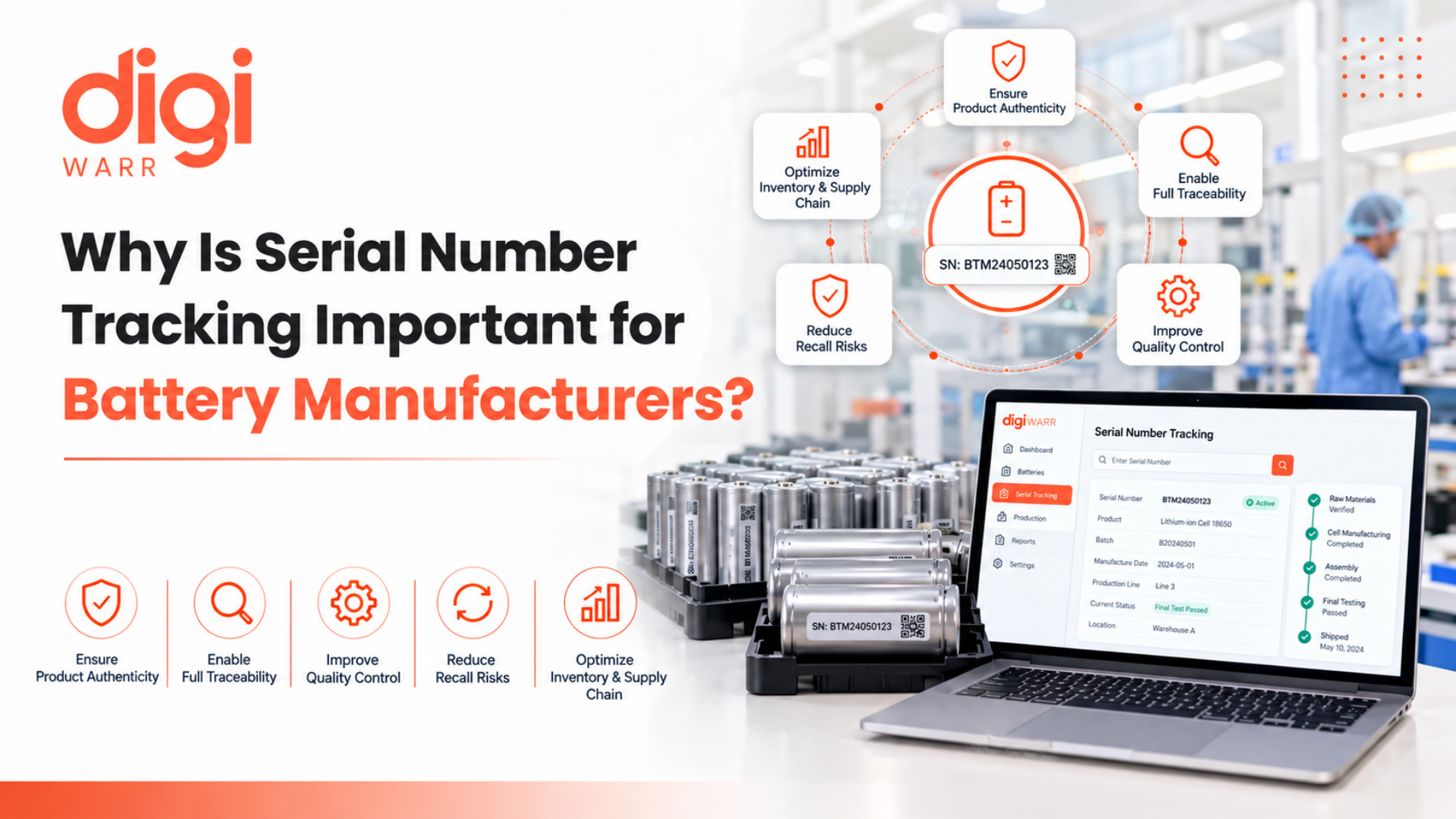
Vikram Deshpande, head of after-sales at a Pune battery manufacturer, received a warranty claim from a Surat dealer for a battery his records placed in a Nagpur distributor’s warehouse. The customer’s bill was five months old. The dispatch register said it left fourteen months ago. Without battery serial number tracking, nobody could say which version was true or whether the claim should be paid.
Table of Contents
ToggleBattery serial number tracking means recording every movement of a battery against its unique serial number, from the day it enters stock to the day it returns as a claim. Each scan adds a fact: where it was made, which warehouse received it, who sold it and when.
In Vikram’s case, the serial number appeared in only two places: the production log and the dispatch register. Everything after Nagpur was invisible, because a printed number helps only when someone captures it at every handover.
A battery can sit in stock, move between distributors and change hands at a dealer counter before anyone uses it. When that trail breaks, the manufacturer pays for the gap: a claim approved on a battery sold outside its grace period, a second replacement for the same unit, or a genuine customer kept waiting.
Regulation points the same way. India’s Battery Waste Management Rules, 2022 make producers responsible for collecting and recycling batteries, and at the end of 2025 the Ministry of Road Transport and Highways released draft guidelines for a 21-character Battery Pack Aadhaar Number to trace EV batteries across their lifecycle. Manufacturers with sound battery serial number management will meet such requirements far more easily.
Battery traceability answers one question quickly: where has this battery been? With scans at inward, dispatch, transfer and sale, Vikram’s team would have seen that the Nagpur distributor moved stock to a Surat dealer last spring. Such transfers are harmless when recorded. When they are not, they look like fraud.
Good battery product tracking also works backwards. If a vendor’s cells prove faulty, serial numbers show which batteries carry them and where they are, so inspections target those units instead of a whole model.
Every warranty question comes back to two dates: when the battery left the manufacturer and when the customer bought it. A serial number activated at the point of sale through a QR scan or SMS settles both, so counter staff no longer depend on a paper bill that may be lost or altered.
Serial records also catch claims that should not pass, such as a unit already replaced, never dispatched or sold after the dealer’s grace period. This is where battery warranty tracking earns its place, stopping invalid claims at the counter instead of in an audit months later.
A battery’s story does not end at its first claim. It may be repaired, replaced, extended or returned as a pro rata case, and each event belongs to the same serial number. Digi Warr keeps them together in Product Kundali, the complete history of each battery, so a service engineer sees past repairs before deciding on a new one.
This battery lifecycle tracking helps beyond the service desk too. Production learns how long a model really lasts, and finance sees which models keep returning within warranty.
Dealers often carry the blame when a claim goes wrong. The Surat dealer had done nothing unusual, yet his claim sat on hold for three days because nobody could prove where the battery came from.
When serial numbers are scanned at receipt and sale, dealers can prove the sale date, raise complete claims the first time and check status without phoning the regional office. Distributor transfers stop looking like unexplained stock losses. A shared battery tracking system gives everyone in the chain the same version of events.
Once claims sit against serial numbers, patterns appear. You can group claims by model, batch, dealer or region and compare them with sales to see the claim ratio. A dealer far above the network average deserves a conversation, and a batch with early failures deserves an inspection.
Serial data also shapes how claims are processed. Under block and wait for approval, the serial key stays blocked while the manufacturer reviews the request so that nobody can claim the same battery at another counter. That control depends on reliable serial number tracking software.
Spreadsheets can store serial numbers, but they cannot follow them. Battery tracking software connects each scan to the next, so inward movement, sale, activation, and claims build one record.
Digi Warr spreads this work across the people who handle the battery. The Warehouse App records inward and dispatch, including expected inward from vendor invoices, so missing units are flagged early. The Outlet App captures sales and activation, and the Service Engineer App adds repairs. Management reviews claim trends on the Bird’s Eye Dashboard, and battery serial number management stops being anyone’s spreadsheet chore.
Vikram’s claim was eventually approved, but it cost three days, a dozen calls and an unhappy customer. With battery serial number tracking in place, the answer would have taken a minute.
Clear serial records protect margins, settle disputes fairly and show management how products behave in the field. Dependable battery warranty management begins long before the first claim.
Want to see how serial-level tracking could fit into your warranty process? Connect with Digi Warr to discuss your current workflow.