


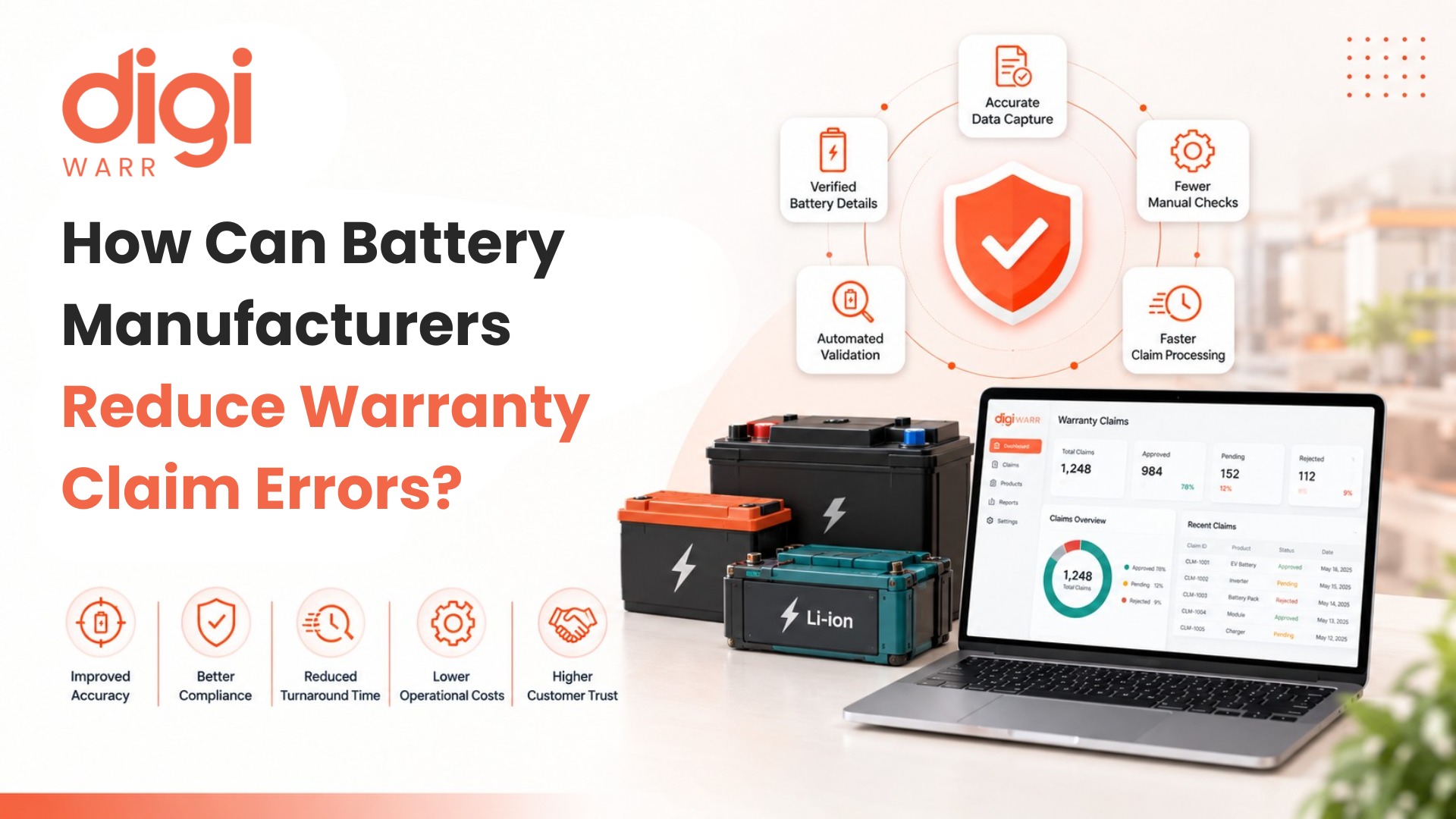
Suresh Iyer heads warranty operations at an automotive and two-wheeler battery manufacturer in Coimbatore. Last quarter, he picked 100 battery warranty claims at random for a spot check and found mistakes in far more of them than he expected. Some claims had paid out money that should have stayed with the company, while others had turned away customers who deserved a replacement. Most of those mistakes he realised, started long before the claim ever reached his desk.
Table of Contents
ToggleNone of the mistakes Suresh found looked dramatic on its own. A dealer had typed an “8” where the serial number had a “B”, so the system couldn’t find the battery and rejected a perfectly genuine claim. The dealer called head office twice that week to complain. Elsewhere, a battery well past its free replacement period was logged as a normal warranty request instead of a pro rata claim, and the customer walked away with a free battery the policy never promised.
A battery that cracked on its way to a distributor had been filed as a customer claim rather than an unsold claim, which hid a transport problem inside the service budget. One serial number even showed up at two dealers three months apart, with a replacement given both times. Every one of these warranty claim errors came from the same place: someone at a counter making a call with incomplete information.
Every wrong decision on battery warranty claims costs you something. Approve a claim you should not and you lose margin. Reject one you should have approved, and you lose the trust of a dealer who has to face that customer again. Both mistakes end up in your claim ratio, one of the first numbers your management team and the market look at.
The amounts involved are large. According to Warranty Week’s annual product warranty report, manufacturers based in the US paid $30.37 billion in warranty claims in 2025, 4% more than the year before. Warranty Week has also reported estimates that fraudulent claims make up 3% to 15% of the average company’s warranty costs, and that range leaves out honest errors like the ones Suresh found.
In India, claim volumes will keep growing. NITI Aayog projects the country’s cumulative battery storage potential at 600 GWh by 2030, driven by EVs, stationary storage and consumer electronics. More batteries mean more dealers and more claims, which is why battery warranty management can’t keep running on memory and paperwork.
The serial number is the one fact every claim should rest on. Battery claim verification begins by checking that serial against a master record. Did the battery exist in your system? Was it dispatched, and was it sold and activated? When dealers scan serials instead of typing them, the “8 instead of B” problem goes away, and genuine customers stop getting turned away.
Digi Warr takes this check all the way back to the point where stock enters your business. Say a warehouse expects 500 serial-numbered batteries from a vendor and receives only 492. With Expected Inward, the eight missing serials stay marked as pending from the start. If a claim ever arrives on one of them under warranty, claim verification flags it at once, because the records show that the battery never reached your shelves. Battery warranty software runs that check in seconds, while a person would rarely think to look.
Many claim errors trace back to one missing moment: the sale. When a dealer activates a battery with a QR scan or an SMS at the time of sale, the serial number, the dealer and the sale date are linked from day one.
That link settles more than the warranty start date, it also tells the system which claim type applies when the battery comes back, so a battery inside its free replacement window goes through as a warranty request and one past it moves to the pro rata route. Counter staff no longer have to decide on the spot. With digital warranty management, registration also shows when a dealer has sold stock after its permitted grace period, so the question comes up at the sale instead of turning into an argument at the claim. Your dealers face fewer awkward conversations, and your battery warranty management follows your policy rather than each counter’s reading of it.
Suresh’s hardest cases were not the ones with wrong serial numbers. They were the ones where nobody could explain why a claim had been approved or rejected. Without a record of the fault, the inspection findings and the reason behind the decision, any rejection can turn into one person’s word against another’s.
Good warranty claim management keeps that record with the claim. In Digi Warr, service engineers log their inspections through the Service Engineer App, and every repair, replacement and warranty extension builds into Product Kundali, the complete history of each battery. When a dealer challenges a rejection six months later, your team can pull up what the inspection found and settle it quickly; dealers benefit too since a decision is easier to accept when the reason is on record. Clear documentation also makes battery warranty claims far easier to audit when finance asks why warranty costs moved.
People get tired, rushed and inconsistent, especially at month-end when claims pile up. Rules do not. With automated warranty claims, you set up your policy once, covering warranty periods, claim types and product models, and every claim follows it no matter which dealer raises it.
The processing model matters as well. Low-risk cases can go through counter replacement, so customers get a quick answer, standard cases can wait for approval from head office, and anything questionable can move to block and wait for approval. Picture a dealer raising a replacement request on a battery with an unusual history; the serial key stays blocked while your team reviews it so that nobody can claim the same battery at another counter in the meantime. That one rule makes warranty claim processing safer without slowing down honest dealers, and it removes a whole category of warranty claim errors.
The duplicate in Suresh’s sample slipped through because the two claims sat in different files at different dealers. When every claim checks the full history of its serial number first, a second claim on the same battery surfaces before any replacement goes out. Warranty claim verification at this level stops the loss at the counter instead of discovering it months later in an audit.
Some problems only appear when you step back. Claim trend analysis in battery warranty software can reveal a dealer whose claims on one model sit well above the network average or a region where failures keep rising. That does not prove wrongdoing. It gives Suresh a fair data backed reason to talk to the dealer, check a batch or review how warranty claim management works in that territory. This gives him the strength and confidence to make a claim that is his. This might look small from a business point of view it gives the businessman a huge upper hand.
Each fix above works best when it lives in one system instead of scattered tools. Battery warranty software such as Digi Warr keeps product movement, claims and service history in one connected record, from vendor inward and warehouse dispatch to dealer sale, activation, claim and repair. Every automated check draws on that same data, and the Bird’s Eye Dashboard shows management the claim ratio and the trouble spots without anyone stitching spreadsheets together. A CFO gets warranty costs that can be explained, a service manager gets fewer disputes, and a business owner gets decisions based on facts.
Battery warranty software works best when a few habits change along with it,
Suresh’s spot check did not uncover a fraud ring, instead, it uncovered gaps in data that began at inward, dispatch and sale then surfaced weeks later as wrong decisions on battery warranty claims once every battery carried a verified history, his team stopped guessing, dealers stopped arguing and finance could trust the warranty line again, a connected warranty system brings that same consistency across your entire dealer network.