


A battery manufacturer that grows from a handful of dealers to a wide distribution network across states usually runs into the same problem sooner or later. Warranty records that once fit into a single register end up scattered across dealer notebooks, service centre files, and half updated spreadsheets. Somewhere in that mess, a genuine claim and a questionable one start looking identical, and nobody can say with confidence which battery is even still under warranty. Battery warranty software exists for exactly this moment, though most manufacturers only realise they need it after the gaps start costing them money.
Table of Contents
ToggleBattery warranty software is a system that manages a battery’s warranty journey from the day it leaves the factory to the day a claim gets resolved, and every step in between. Instead of depending on paper registers or a spreadsheet that lives on one person’s laptop, proper battery warranty management software keeps registration, serial data, claim history, and dealer activity connected in one place.
This matters more than it sounds. A battery’s warranty story does not begin when a customer walks in with a complaint. It begins when the product enters inventory, moves through a warehouse, gets sold by a dealer and eventually reaches a customer who may not remember the exact purchase date. When all of that information stays connected, a manufacturer can answer a warranty question in minutes instead of spending days calling three different people just to piece the story together.
What Features Should Battery Warranty Software Include?
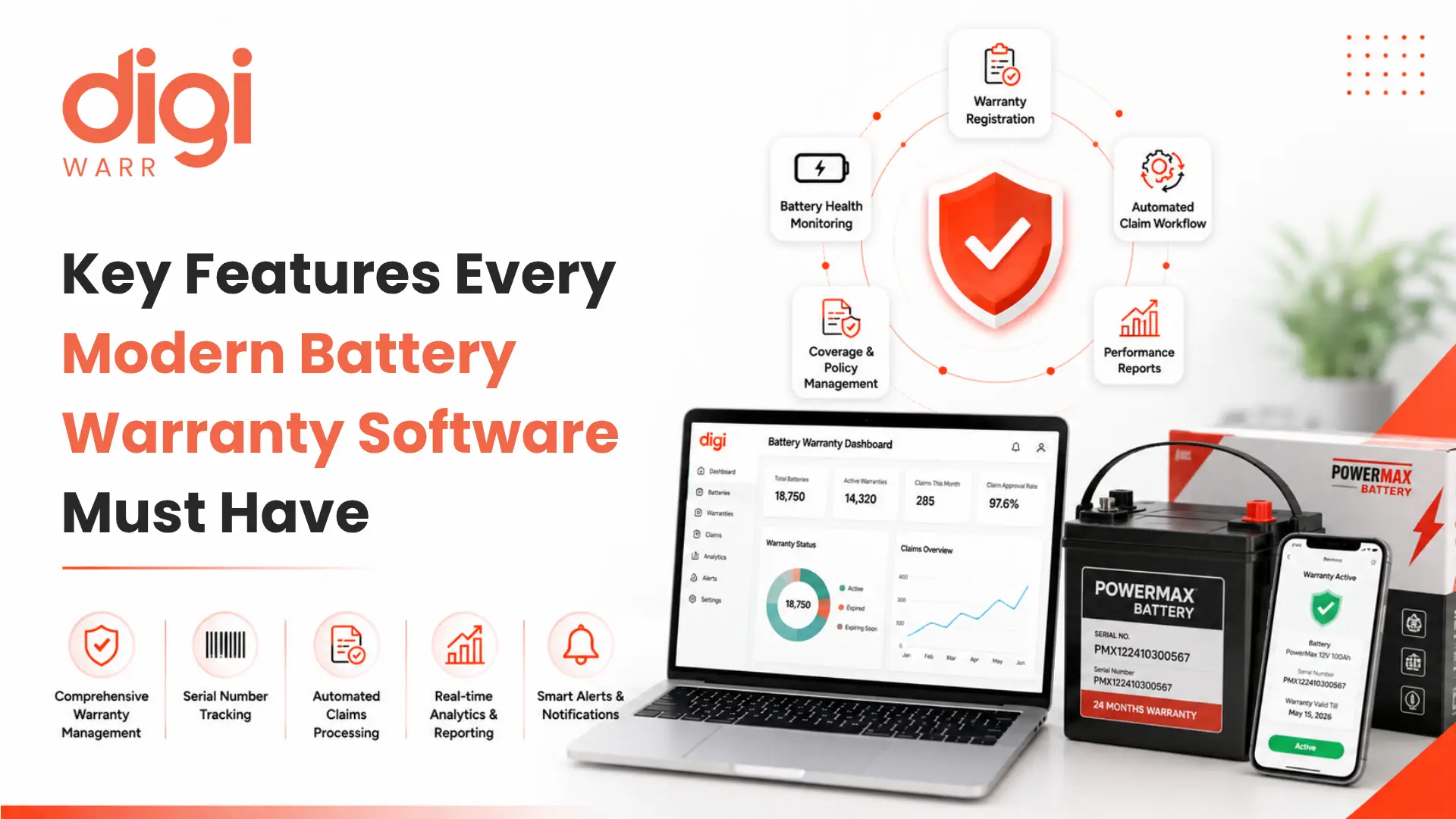
Not every warranty tool on the market does the same job, so it helps to know what to actually look for. The strongest battery warranty claims software shares a handful of features that solve real operational problems rather than just looking good in a demo.
Paper registration cards get lost, filled out incorrectly or never submitted at all, which leaves a manufacturer with no accurate record of when a battery actually reached its customer. Battery warranty registration through a QR code or a simple digital form fixes this at the source. A customer scans a code at the point of purchase, and the purchase date, dealer and serial number get recorded instantly instead of relying on someone’s memory three months down the line.
A single serial number can tell an entire story, provided the software actually tracks it properly. Battery serial number tracking connects a battery’s vendor details, warehouse movement, dealer sale and claim history into one continuous record. If a customer arrives with a battery and a disputed purchase date, the serial number settles the question in seconds instead of turning into a back and forth argument between the dealer and the company.
Manual claim approval usually means someone checking eligibility by hand, calling the dealer and hoping nothing slips through the cracks. Automated warranty claims processing removes most of that guesswork by routing each request through the right workflow on its own whether that means a straightforward counter replacement, a wait for approval stage or a block and wait process where the serial key stays restricted until the company makes a decision.
Good software does not just process claims, it also observes them. When claim volumes spike for a particular model, dealer or region, the next step of the system should be to flag it before it turns into an expensive pattern instead of staying buried as a set of isolated incidents, this turns claim ratio from a number sitting in a report into something management actually uses to make decisions.
Since most battery sales pass through dealers or distributors before reaching a customer warranty software needs to give everyone in that chain the same information, shared visibility into grace periods and stock movement prevents the kind of dispute where a customer believes a battery is covered while company records show the dealer sold it long after the permitted window had closed.
Together, these features turn warranty software for batteries from a claim logging tool into something closer to a full operations partner.
The actual claim journey looks fairly simple once the right system is in place. A customer or dealer raises a request, the software checks the serial number against warranty eligibility and grace period rules and the claim gets routed based on the company’s policy. Some claims qualify for counter replacement right away, while others move into a wait for approval stage, where the dealer sends the details to the manufacturer and waits for a decision. In cases that need closer review, the serial key can be blocked entirely until approval comes through, which stops the same battery from being claimed twice or processed at two locations at once.
Every decision once made gets logged against that battery’s history, good battery claim management depends less on speed alone and more on making sure each claim moves through a process that both the dealer and the customer can trust.
Grace periods create some of the most common warranty disputes in the battery industry, and most of them trace back to weak serial tracking. A manufacturer might give dealers a defined window, say six months, to sell inventory before it falls outside standard warranty terms. Problems begin when a dealer sells that stock after the window closes without updating anyone. The customer, holding a recent purchase receipt reasonably assumes the battery still carries a valid warranty while company records tell a different story entirely.
Strong battery serial number tracking catches this gap immediately by comparing the actual sale date against the recorded grace period long before it turns into an argument at the counter. It also helps during inward stock checks. If a warehouse expects 500 serial numbered batteries from a vendor and receives only 492 the missing eight show up right away instead of surfacing months later as an unsolved mystery.
Automation earns its place in battery warranty management by removing the small manual steps that quietly add up to real delays. Instead of someone checking eligibility by hand, cross referencing spreadsheets, and following up on approvals over email, the system handles notifications, routing and status updates on its own.
This matters financially too. Deloitte has estimated that greater use of analytics and AI in warranty processes could save a market leading automotive manufacturer with around $135 billion in annual revenue between $200 million and $270 million a year, based on typical warranty costs running at 1% to 2% of revenue. Battery manufacturers operate at a smaller scale, but the underlying principle still holds true. Every claim resolved through automation instead of manual reconciliation is a claim that costs less and takes less time to close.
Customers rarely think about the backend architecture of a warranty system. They care about getting a clear answer quickly when something goes wrong with a product they paid for. When registration, serial data and claim history sit in one connected system, a service team can confirm eligibility and move forward with a resolution the same day, instead of asking the customer to wait while someone digs through old records.
This same visibility helps after sales teams as well, since they stop fielding repeated calls asking for updates on a claim that is already being processed. A dealer no longer has to guess whether a replacement request will get approved, because the status changes are visible the moment they happen. Fewer disputes and faster answers end up mattering more to customer trust than almost anything else in the warranty process.
A few habits tend to undo the benefits of even a good warranty system, so it helps to watch for them:
Warranty Week’s most recent Annual Product Warranty Report found that U.S. manufacturers paid over $30 billion in product warranty claims in a single year, with claims rates continuing to climb across industries including automotive. Numbers like that make it clear why manufacturers cannot keep managing battery warranties through disconnected records for much longer.
The right battery warranty software does not just process claims. It protects product history, keeps dealers accountable and gives management the visibility to make better decisions long before a small issue turns into an expensive pattern. Want to see how this could fit into your current warranty process? Connect with Digi Warr to talk through your workflow.