


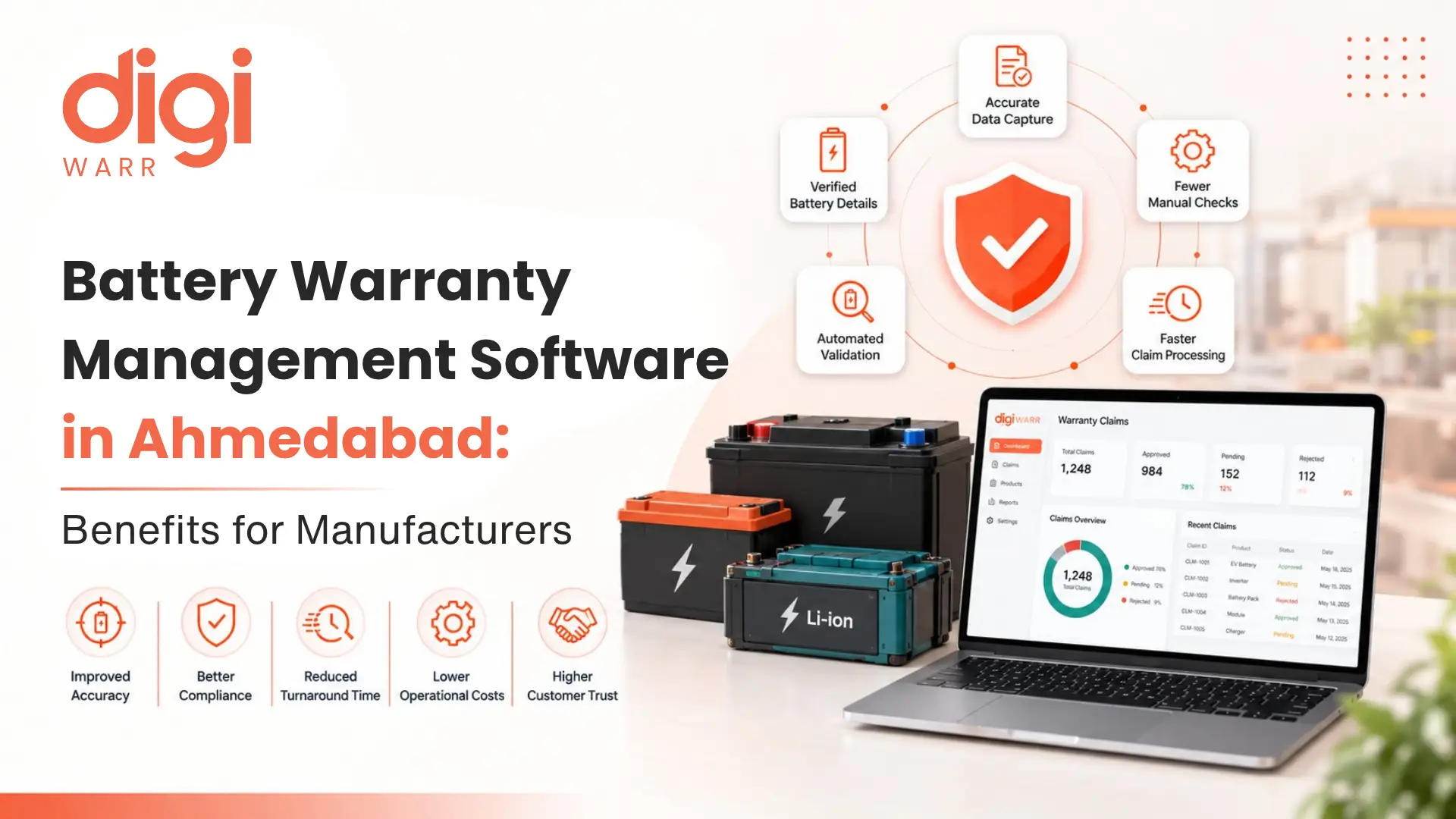
Hitesh Parikh runs an automotive and inverter battery plant in Vatva GIDC. In five years, his dealer network grew from 60 outlets to almost 180 across Gujarat and Rajasthan, but his warranty process stayed the same: a claims register, three spreadsheets and a WhatsApp group. When his CFO asked what warranty had cost the company last quarter, nobody could answer with confidence. That question is where battery warranty management software in Ahmedabad starts to make sense for manufacturers like him.
Table of Contents
ToggleBattery warranty management software is a system that records every battery’s warranty journey against its serial number. It starts when stock enters your warehouse, continues through dispatch and sale, and covers every claim, repair, replacement and extension that follows.
For Hitesh, the problem was never a lack of information. His dealers knew the sale dates, his service team knew the failure reasons, and his warehouse knew what went out. Each team simply kept its own version. A warranty management software platform puts all of it in one record that everyone can trust.
The first benefit is control. When each claim is checked against the battery’s real sale date and history, your team stops approving claims on guesswork. Duplicate claims, stock sold long after dispatch and batteries already replaced once become visible at the counter instead of in an audit.
The second benefit is speed. Dealers get decisions faster, and customers stop waiting weeks for a replacement. Good battery warranty software also gives each department something useful. The owner sees the overall claim picture, finance sees warranty costs by model and region, and sales gets a dealer network that trusts the brand’s warranty promise.
There is a market reason too. Gujarat is fast becoming a battery manufacturing region, with Agratas building a 20 GWh cell plant at Sanand that is due to start production in 2027. Battery manufacturers in Ahmedabad will compete for dealers and customers on service as much as on price, and a clean warranty record is part of that service.
In Hitesh’s office, two people spent most of each week typing claim details from photos into spreadsheets and calling dealers for missing serial numbers. That work added no value. It only moved information from one place to another.
Automated warranty management removes those steps. The dealer enters a serial number, and the system fills in the model, sale date and remaining warranty on its own. Claims missing key details cannot be submitted, so nobody chases them later. Each claim then follows the route your policy sets: counter replacement for clear cases, wait for approval for doubtful ones, or block and wait for approval when the serial key must stay locked during review. Your team spends its time deciding claims instead of collecting them.
A battery warranty tracking system follows each battery through a series of recorded events. Stock is scanned at inward and dispatch. The dealer activates the battery at the time of sale, which fixes the warranty start date. Any claim, inspection, repair or replacement is then added to the same serial number.
Digi Warr keeps this record in Product Kundali, the complete history of each battery. When one of Hitesh’s dealers in Udaipur raises a claim, the service team can see where that battery came from, when it was sold and whether it has failed before. Grace period checks also run in the background, so stock sold well after the dealer was meant to clear it is flagged before the claim is approved.
Features matter only when they solve a daily problem. These are the ones battery makers tend to rely on most:
Battery claim management software that covers these areas keeps your process consistent as the network grows.
Paper warranty cards get lost, and handwritten bills are easy to dispute. When a customer returns with a failed battery and no proof, the dealer has to choose between upsetting the customer and risking an invalid claim.
Digital warranty registration removes that choice. Once the battery is activated by QR scan or SMS at the point of sale, the customer’s warranty lives in the system rather than in a drawer at home. The dealer only needs the serial number to confirm coverage.
That makes battery service management calmer at the counter, because the conversation moves from “do you have the bill?” to “let’s check your battery.” Customers get a quicker answer, dealers avoid awkward arguments, and the manufacturer gets an accurate record of who owns which battery.
Start with your own process, not the software demo. List how your batteries move from vendor to warehouse, distributor, dealer and customer, then check whether the system can follow each of those steps. Ask these questions before you decide:
Local support matters more than many teams expect. Choosing battery warranty management software in Ahmedabad from a team that understands Gujarat’s dealer networks makes rollout and dealer training far smoother.
It also helps to check what the product was originally made for. Choose battery warranty solutions designed around warranty operations, not general software with a warranty tab added later.
Warranty is a real cost line. Warranty Week reported that US-based manufacturers paid $29.176 billion in warranty claims in 2024, an average of 1.329% of product sales. Battery makers in India work on a smaller scale, but the share of revenue lost to poorly controlled claims can be just as serious.
Warranty tracking software reduces that cost in several ways. Invalid and duplicate claims are stopped early. Fewer staff hours go into manual entry and follow-up calls. Dealer settlements are reconciled against clear records, and the Bird’s Eye Dashboard shows management where claims are rising before costs build up. For Hitesh’s CFO, the warranty line finally becomes a number he can explain.
Hitesh’s dealer network will keep growing. The real question is whether his warranty process grows with it or keeps falling behind. With battery warranty management software in Ahmedabad, every claim, sale and repair sits in one record, and the next quarterly review starts with answers instead of guesses.
Better warranty visibility gives you control over costs, dealers and customer trust. Want to see how this could work across your dealer network? Connect with Digi Warr to discuss your current warranty workflow.